Which Stepper Motor Do You Need?
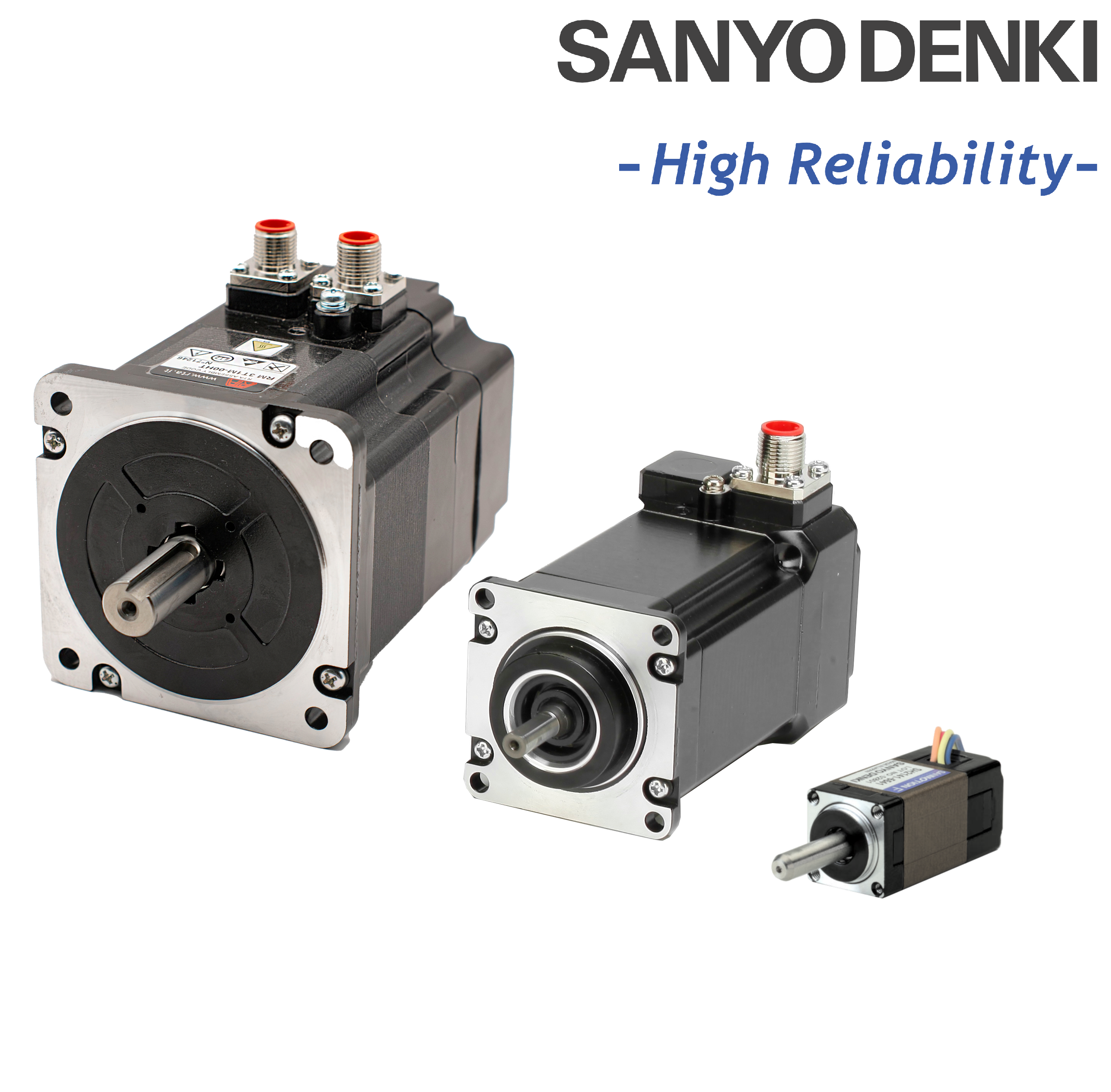
- Stepper Motors with Connectors: RH, RM — Application requirement: Fast wiring and easy replacement — Key features: Compact RH motors with JST connectors; RM motors with industrial M12 connectors and IP54 protection.
- Stepper Motors with Flying Leads: SH, SS, SM, 103-H — Application requirement: Customized machine wiring — Key features: Frame sizes ranging from miniature 14 mm motors up to 106.4 mm.
- IP65 and Full IP65 Stepper Motors: SP Series — Application requirement: Dust, moisture and washdown environments — Key features: IP65 motor housing protection; Full IP65 versions (SX suffix).
- Encoder and Brake Versions — Application requirement: Position feedback or load holding — Key features: Incremental encoders (400 or 4,000 cpr) or multi-turn absolute encoders; brake versions (.B suffix).
RH, RM and SP Series: SANYO DENKI Industrial Stepper Motors
The RH series is designed for applications requiring a compact stepper motor with an integrated connector. The RH 1S1M, for example, features a 42 mm flange (NEMA 17) and a holding torque of 43 Ncm.
The RM series features industrial M12 connectors, an IP54 protection rating and CE, UL and CSA certifications. The RM 3R2M has an 86 mm flange and a holding torque of 700 Ncm. RM 3T2M versions add incremental or multi-turn absolute encoder options, enabling closed-loop motion control when paired with X-PLUS drives.
The SP series is designed for environments exposed to dust and water. All models feature IP65 protection, while Full IP65 versions extend protection to the entire motor assembly.
Alongside connector-equipped models, traditional SANYO DENKI stepper motors with flying leads (SH, SS, SM and 103-H) cover sizes from NEMA 6 to NEMA 42. They are suitable for both new machine designs and replacement applications in existing equipment.
NEMA 17, NEMA 23 and NEMA 34: How to Choose the Right Frame Size
NEMA 17, NEMA 23 and NEMA 34 designate standardized mounting flange dimensions, not motor torque.
Two NEMA 23 stepper motors may have significantly different body lengths, current ratings and performance characteristics. In a new machine design, the appropriate frame size should be determined through load calculations.
For motor replacement, NEMA size is an important starting point, together with shaft diameter and length, overall dimensions, connector type and current rating.
The RTA catalog includes NEMA 6, 11, 17, 23, 24, 34 and 42 stepper motors. Use the NEMA size, flange dimensions, current and protection rating filters to narrow down your selection.
Stepper Motors with Encoder, Brake or Double Shaft
An encoder measures the actual rotor position. When combined with an encoder-feedback drive such as X-PLUS MS4, AS4 or CSD MS8, the motor operates in a closed-loop system, allowing the drive to detect missed steps and, where supported, correct positioning errors.
A brake holds the load when the motor is not powered, making it particularly useful for vertical axes.
A double-shaft stepper motor allows the connection of a handwheel, an external encoder or an additional mechanical component.
Why Choose a Stepper Motor?
A stepper motor performs precise incremental movements without necessarily requiring position feedback. It delivers high torque at low speeds and is easy to control.
Stepper motors are often a cost-effective solution for positioning, indexing, dosing and intermittent motion applications.
However, actual performance depends on the complete motion system, including the motor's torque-speed characteristics, drive, load and mechanical transmission.
How to Size a Stepper Motor: Five Key Parameters
- Load and inertia: Mass to be moved, mechanical transmission, friction and rotating components.
- Operating speed: The speed at which useful torque is required, not just the maximum speed.
- Acceleration and duty cycle: Acceleration ramps, deceleration times and start-stop frequency.
- Electrical and environmental requirements: Supply voltage, current, IP protection rating, available space and wiring.
- Control and feedback: PLC interface, encoder requirements and diagnostic functions.
The most important parameter is the available torque at the required operating speed, determined from the torque-speed curve using the intended drive and an appropriate safety margin.
Motor and Drive: Why RTA Offers Them Together
Supply voltage, regulated phase current and microstepping settings all influence stepper motor performance at different operating speeds.
For this reason, the key question is not "Which motor has the highest torque on paper?" but rather "Which motor-drive combination can meet the application's operating requirements?"
RTA manufactures drives for stepper motors and distributes SANYO DENKI motors, allowing customers to select a motor-drive combination with verified compatibility.
Stepper Motor with Planetary Gearbox
When an application requires lower output speed and higher output torque, an SG series planetary gearbox can be mounted directly onto SANYO DENKI motors using the Plug & Go solution.
The gearbox increases output torque, reduces reflected load inertia and improves output positioning resolution.
Stepper Motor or Brushless Servo Motor?
If the application requires high dynamic performance, continuous torque at high speeds or dedicated torque control, compare the stepper motor solution with SANYO DENKI brushless servo systems.
The comparison should consider the complete motion system under equivalent operating conditions.