


Stepper Servodrives
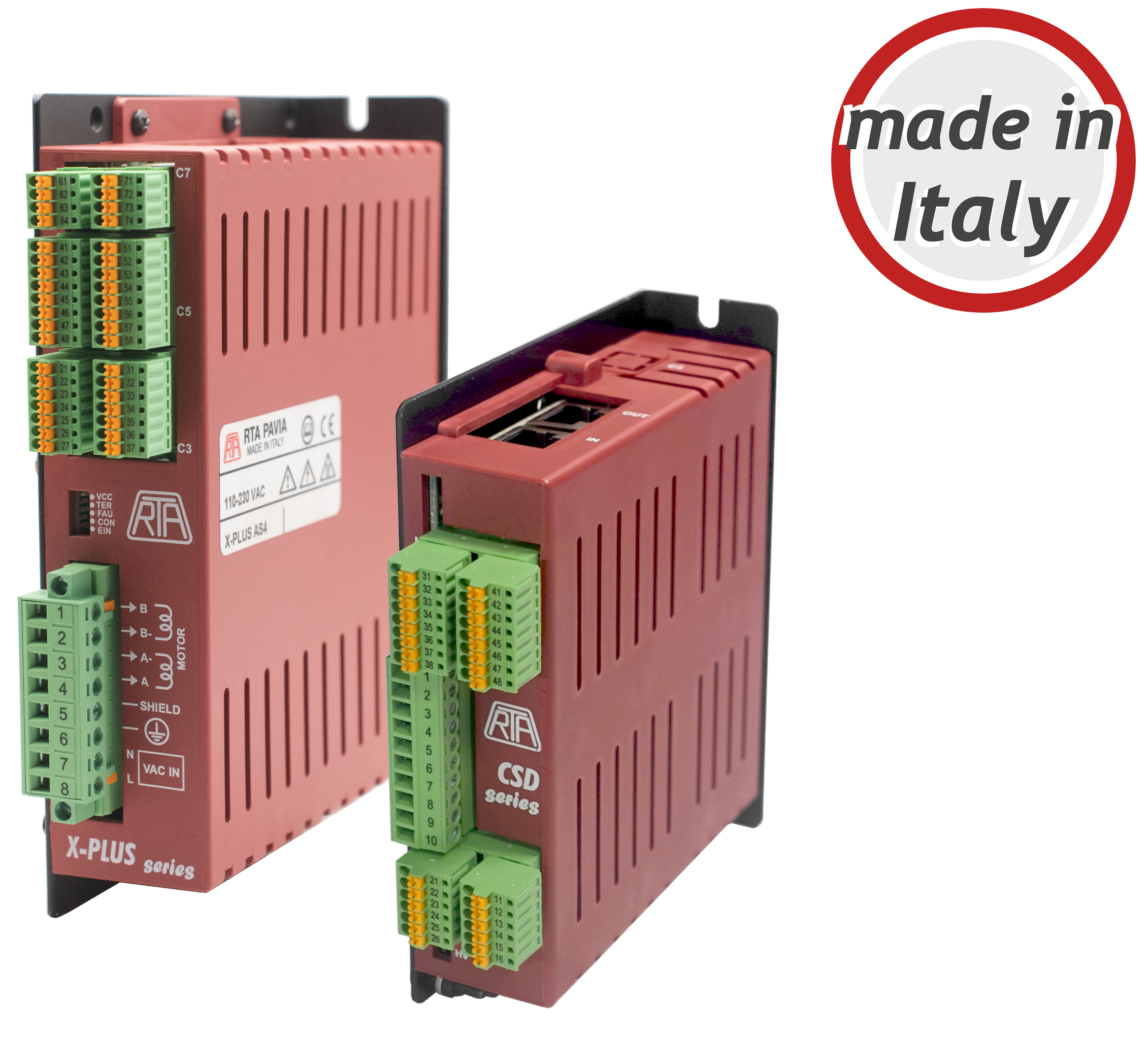
A complete lineup of Made in Italy drives featuring over 60 models, split into 6 main categories: Step and Direction, Step and Direction Advanced, Analog Input, Programmable, CANopen, EtherCAT, EtherNet/IP, and Modbus TCP/IP.


102 products
Stepper Motor Drives Designed and Manufactured in Italy
RTA has been designing stepper motor drives since 1976. Today, development, manufacturing and testing still take place at our headquarters in Marcignago (Pavia), Italy, where every drive undergoes two rounds of testing before shipment.
Our product range includes over 90 industrial stepper motor drives: Step & Direction models for PLC control, versions with encoder feedback, programmable drives, and solutions supporting EtherCAT, EtherNet/IP and Modbus TCP/IP communication interfaces, with supply voltages ranging from 24 VDC to 230 VAC.
Choosing an Italian manufacturer means having direct access to the engineers who designed the electronics. RTA's technical support team helps you select and size the right stepper motor driver and match it with the most suitable stepper motor for your application. RTA is the exclusive distributor of SANYO DENKI motors in Italy.
Have you already selected your motor, or are you designing a new motion axis? Compare the product families below or contact our technical support team with your application requirements.
Which Stepper Motor Drive Should You Choose?
RTA stepper motor drives are divided into five groups, based on how they receive commands and communicate with the machine.
- Step & Direction — Machine requirement: Axis controlled by a PLC or motion controller using pulse signals — Reference models: BSD02, A-CSD, HGD, PLUS, X-PLUS L2, MIND, X-MIND; Eurocard GMD and GMH for rack mounting.
- Step & Direction with Encoder Feedback — Machine requirement: Position feedback and detection of missed steps — Reference models: X-PLUS MS4, X-PLUS AS4 (absolute encoder), CSD MS8.
- Fieldbus — Machine requirement: Industrial communication networks and centralized diagnostics — Reference models: CSD ET and X-PLUS ET (EtherCAT), CSD HT (EtherNet/IP), CSD MT and X-PLUS MT (Modbus TCP/IP), FLEX-DRIVE.
- Multibus Combo Units — Machine requirement: Multiple communication protocols on the same platform — Reference models: HI-MOD and R-MOD, NEMA 23, 24 and 34 frame sizes.
- Programmable Drives — Machine requirement: Locally managed motion sequences without a dedicated PLC — Reference models: CSD J, MIND T, X-MIND K, encoder-equipped .P versions.
Datasheets are available for download for all models. Supply voltage, current ratings and communication interfaces should always be checked against the exact product code.
Step & Direction Drives: The Simplest Connection to a PLC
When the controller generates step and direction pulses directly, a Step/Dir drive provides the most straightforward solution. It is commonly used for positioning axes, dosing systems and indexing tables. The PLC calculates the motion trajectory, while the drive regulates the current flowing through the motor windings.
The RTA range includes compact DC-powered drives and versions powered directly from a 110–230 VAC mains supply. Eurocard formats are also available for rack-mounted electronics. Some models, such as X-PLUS, also support a ±10 V analog input and Modbus RTU communication over RS-485.
This is an ideal choice for applications requiring a PLC-controlled stepper motor driver without introducing an additional industrial communication network.
EtherCAT, EtherNet/IP and Modbus TCP/IP Stepper Motor Drives
Multi-axis machines often need to exchange parameters, operating status and alarm information with a central controller. In these applications, an EtherCAT stepper motor drive or an industrial network-enabled drive simplifies wiring and diagnostics.
RTA supports three communication protocols. EtherCAT is available on the CSD ET, X-PLUS ET and FLEX-DRIVE families. EtherNet/IP is supported by CSD HT, while Modbus TCP/IP is available on CSD MT and X-PLUS MT.
The choice depends on the communication network already installed on the machine. The protocol itself does not change the motor's torque characteristics, but it allows motion commands and process information to be integrated into a single automation architecture.
Stepper Motor Drives with Encoder Feedback: X-PLUS and CSD MS8
The Step & Direction drives with encoder feedback measure the actual rotor position. This enables them to detect loss of synchronization and provide more reliable motion control when load conditions change.
X-PLUS AS4 operates with an absolute encoder and retains the position reference. X-PLUS MS4 and CSD MS8 complete the range of drives designed for encoder-equipped stepper motors.
These platforms also integrate the STO (Safe Torque Off) SIL3 safety function, helping simplify machine safety design. Programmable versions (.P) are also available, allowing motion sequences to be managed directly by the drive.
For a suitable motor combination, explore the RTA stepper motor range, including models with incremental or multi-turn absolute encoders.
Programmable Stepper Motor Drives: Motion Control Logic Built into the Drive
When a simple machine does not justify a dedicated PLC, a programmable stepper motor drive can execute motion sequences, waiting times and I/O management locally.
The MIND, X-MIND and CSD J families cover stand-alone applications and serial communication networks. X-MIND, for example, allows up to 48 drives to be managed on the same RS-485 communication line.
How to Match a Stepper Motor with the Right Drive
Even the best stepper motor driver cannot deliver optimal performance if the motor has been selected without considering the actual operating cycle.
Proper sizing starts with the torque-speed curve, measured using the intended power supply and drive. The motor's holding torque at standstill provides limited information about the torque available at the required operating speed.
For correct motor and drive selection, prepare the following application data:
- Motion profile
- Operating speed
- Load mass and inertia
- Mechanical transmission
- Available supply voltage
- Motor current rating
- Control cabinet temperature
- Control interface requirements
If the application requires higher torque at low speeds, consider an RTA planetary gearbox designed for integration with SANYO DENKI motors.
Phase Current and Microstepping
RTA stepper motor drives cover phase currents from 0.6 A up to 14 A.
The current setting depends on the motor specifications, the winding connection (series or parallel) and the operating conditions. Rated current and peak current must always be compared under equivalent conditions.
Microstepping, with resolutions of up to 12,800 steps per revolution on advanced models, produces smoother motion while reducing vibration and audible noise.
Mechanical characteristics also influence resonance: transmission stiffness and acceleration ramps remain important parameters to optimize during commissioning.
Stepper Motor Drive or Brushless Servo System?
Stepper motor technology is often an efficient solution for positioning axes with well-defined loads.
When an application requires very high dynamic performance, continuous torque at high speeds or dedicated torque control, it is worth comparing stepper technology with a SANYO DENKI brushless servo system.
RTA offers both technologies and helps you select the most suitable motion control solution based on your machine's operating cyc
Typical Applications
RTA stepper motor drives are used in packaging machines, dosing systems, labeling equipment, textile machinery, test benches, material handling systems and special-purpose automation equipment.
In all these applications, proper motor-drive matching, seamless PLC integration and access to technical support from engineers with in-depth knowledge of the drive electronics are essential.
Frequently Asked Questions About Stepper Motor Drives
What is the difference between a Step/Dir drive and an EtherCAT drive?
A Step/Dir drive receives step and direction pulses from the controller. An EtherCAT drive receives commands and provides diagnostic information through the industrial communication network. The available torque depends on the combination of motor, drive and power supply, not on the communication protocol.
How do you set the current on a stepper motor drive?
Start with the motor's rated current and the winding connection configuration. Then verify the drive's current limits and the thermal conditions inside the control cabinet.
Do you always need a stepper motor with an encoder?
No. An encoder is required when the actual motor position needs to be monitored or potential missed steps must be detected and compensated for. Many positioning axes operate reliably in open-loop mode.
Are RTA drives compatible with any stepper motor?
RTA drives are compatible with most bipolar hybrid stepper motors. However, current ratings, supply voltage and winding connections must always be verified. For SANYO DENKI motors distributed by RTA, compatible motor-drive combinations are already documented.
Where are RTA stepper motor drives manufactured?
RTA stepper motor drives are designed, manufactured and tested at RTA's facility in Marcignago (Pavia), Italy.
Find the Right Stepper Motor Driver for Your Machine
Are you sizing a new motion axis, integrating a PLC or replacing an existing stepper motor drive?
Send your motor specifications, motion profile and communication network requirements to RTA Technical Support.
Get expert advice directly from the engineers who design the drives.